

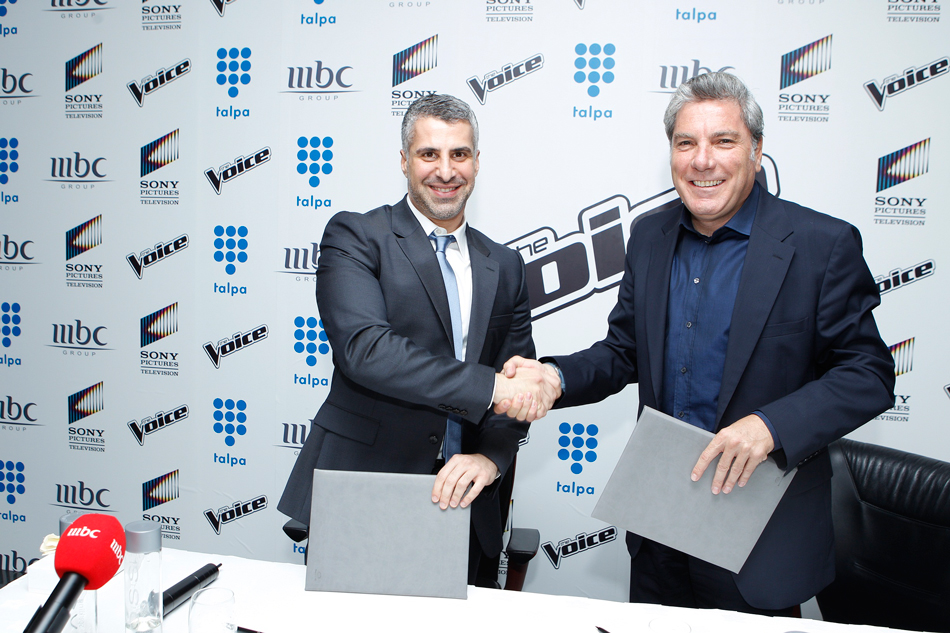
Contract signed between MBC Group, Talpa & Sony Pictures Television Arabia
Dubai, UAE May 14th 2012: During a press conference held at MBC Group Headquarters in Dubai, a contract was signed between MBC Group, Talpa and Sony Pictures Television (“SPT”) Arabia, by which MBC Group acquired the exclusive rights to broadcast the international TV format “The Voice”, on multi-platforms, across the Middle East and North Africa (“MENA”) region. SPT Arabia- the producer- which represents Talpa formats in the region will co-produce the show in its local adaptation.
Ali Jaber, Group TV Director, MBC Group, said: “We are pleased to announce this multi-year agreement today, in our capacity as the exclusive broadcaster of this international format that has gained much popularity and viewership across the world. We now offer the 3 strongest talent show formats in the region, across multi-platforms, and look forward to continuously bring the best of entertainment to our loyal viewers, browsers and followers”. Jaber added: “Talent shows have positively affected the TV viewing habits, patterns and trends in the region, while further enhancing the family viewing experience and raising the levels of engagement with TV content, through social media and other platforms”.
From his side, Maarten Meijs, Managing Director of Talpa Distribution, the owner of the format, commented: “In the Western world, “The Voice” is recognized as a new generation in its genre. We trust the same will happen in the MENA region, regardless of cultural differences, as all people love music and have their one unique language to discuss who and what they like the most.”
Further elaborating on this partnership, Ziad Kebbi, President of SPT Arabia, added: “We’re very excited to co-produce “The Voice” – the format is a blockbuster and now it’s our region’s turn to take up the mantle. In particular, social media and digital extension will play a major role in our production activity; both key elements in uniting the audience across various territories.”
In 2011 and earlier this year “The Voice of Holland”, the original version of the show, was the most watched talent competition in the history of Dutch TV. In the US, with network NBC, “The Voice” was the number one show when it comes to the introduction of a new entertainment formats on TV in many years. Both France (TF1) and UK (BBC) witnessed similar popularity and viewership ratings. By early 2012, “The Voice” was commissioned to over 45 broadcasters all over the world and on air in some 140 territories. And today “The Voice” has been added to MBC Group – covering the MENA region.
Auditions for “The Voice” are being organized in countries including the United Arab Emirates, Egypt, Kuwait, Tunisia, Lebanon and Morocco, and others. The show will broadcast from MBC’s studios in Beirut- Lebanon, soon.



“The Voice” as a format
The series consists of three phases: a Blind Audition, a Battle Phase, and Live performance shows. Four coaches, all famous musicians, will choose teams of contestants through a blind audition process. Each coach has the length of the auditionee’s performance to decide if he or she wants that singer on his or her team; if two or more judges want the same singer then the singer gets to choose which coach they want to work with.
Each team of singers will be mentored and developed by their coach. In the second stage, coaches will have two of their team members’ battle against each other by singing the same song, with the coach choosing which team member will advance to the next stage. In the final phase, the remaining contestants will compete against each other in live broadcasts. The television audience will help to decide who moves on. When one team member remains for each coach, the contestants will compete against each other in the finale.
Program Fact Sheet: “The Voice”
Background:
“The Voice” is the latest talent music format. Originally a Dutch format, it received world-wide success when it first launched in the USA featuring four famous recording artists as the shows mentors & coaches.
The format is uniquely distinguished from other talent shows through “The Blind Auditions” and the “Coaches” with the revolving chairs. These opening rounds are the true test of concept and premise of the show – performers sing on the stage without the Coaches being able to see them. If the Coaches like what they hear – they hit their “I Want You” button and their chairs revolve to face the singer.
“The Battle Rounds” are also another original element in the format. Most importantly, the 4 coaches also compete with each other through their teams of contestants.
Program concept:
- 4 of the most popular Arab artists are in search for an amazing voice in the region. Their objective: to find pure and real talents with strong vocal capabilities. For that purpose, the selections are “blind”: looking for “The Voice”…
- The contestants cannot be seen, they can only be heard.
- If a coach is impressed by a contestant’s voice, he/she pushes the “I Want You” button to select the contestant. At this point, the coach’s chair will swivel to face the contestant selected. If more than one coach selects the talent, the power shifts to the contestant, who may choose which coach they want to work with throughout the competition.
- If none of the coaches presses the button, the candidate is automatically sent away.
- At the end of the blind auditions, each coach would have picked 12 contestants.
- The contestants move from the first phase to the second which is the Battle Phase.
- During the battle rounds, the coaches with the help of their professional dream teams will put two of their own team members against each other to sing the same song together in front of a studio audience. After the vocal face-off, the coach must choose which singers will advance and which singers will be eliminated.
- At the end of the battle episodes, only the strongest members of each coach’s roster remain and proceed to the live stage shows. In this final performance phase of the competition, the top contestants from each team will compete against each other during a live broadcast.
- The public will vote for the most beautiful and talented voice from among the four candidates who have been selected by the coaches. The winner will sign a contract for a new album, and a video clip with the production company.
- The selection process of the candidates will be among thousands of applicants, of which 150 will arrive to the first phase.
- The program consists of 3 phases: (1) Blind Auditions; (2) The Battle Rounds; and (3) The Live Performances
Round 1, the “Blind Auditions”: 5 episodes; each 75 minutes
The contestants cannot be seen, they can only be heard.
If a coach is impressed by a contestant’s voice, he/she pushes the “I Want You” button to select the contestant. At this point, the coach’s chair will swivel to face the contestant selected. If more than one coach selects the talent, the power shifts to the contestant, who may choose which coach they want to work with throughout the competition. If none of the coaches presses the button, the candidate is automatically sent away.
At the end of the blind auditions, each coach would have picked 12 contestants.
Round 2, the battles “Battle Rounds”: 3 episodes; each 75 minutes
During the battle rounds, the coaches with the help of their professional dream teams will pit two of their own team members against each other to sing the same song together in front of a studio audience. After the vocal face-off, the coach must choose which singers will advance and which singers will be eliminated. At the end of this round, coaches would have 6 team members left in their teams.
Round 3, the lives “Final Battle Rounds”: 6 episodes; each 129 minutes
At the end of the battle episodes, only the strongest members of each coach’s roster remain and proceed to the live stage shows. In this final performance phase of the competition, the top contestants from each team will compete against each other during a live broadcast.
During each episode, the audience will save one contestant from each team, and the coach (team leader) will also save one. This round includes the semi final and “The Finale”.
Semi Final structure: Episode 13
- 2 Talents per coach
- The coach and the viewers decide who progresses to the Final
- With each talent a single (a total of 8 singles) will be recorded prior to the Semi-Final
- 8 singles recorded and ready (+ downloads)
The Finale structure: Episode 14
- 1 Talent per coach
THE SOCIAL MEDIA ROOM
- Home of all social media during the live shows on TV
- All talents chat with their fans and followers immediately before and after their performance
- Live tweets
- Facebook and other social media integration with screens in the Social Media Room
THE COACHES
The coaches play a crucial role. Four extremely successful performing artists/singers – with huge successes to their name – take each other on in the battle to find the new singing star. With these four top performers (The Coaches) fronting the show and the fact that quality is the key word, the credibility and the cooperation from the music industry will be huge.
THE DREAM TEAMS
Literally and figuratively, these teams only come into the picture during The Battle. These are the specialists in the coach’s inner circle. They may be stylists, producers, singing teachers, speech therapists and other experts. These will preferably be people who the coach works with or has worked with in the past.
The rehearsals will also be attended by a dance coach who will stage the candidates in consultation with the coaches. The coaches’ dream teams will also feature on screen. This means that they must also be able to play their role as advisors with the camera running. In addition, the dream team must grasp that their contribution should also help to build up tension and excitement within the episode.
The coach will discuss with them which supervision a candidate needs to take for the next step. The coach will also discuss with his or her support team which talents should drop out in “The Battle” shows and in the “Live” shows. The support team will really come into the picture during the recordings for The Battle episodes. Together with the editorial team, the members of the support teams will determine the choice of song for The Battle and Live shows. They are also jointly responsible for choosing the type of arrangement for the songs.
About MBC Group
MBC Group is the first private free-to-air satellite broadcasting company in the Arab World which was launched in London in 1991 and later moved to its headquarters in Dubai in 2002. Over the past 20 years, MBC Group has grown to become a well-established media group that enriches people’s lives through information, interaction and entertainment. Based in Dubai, in the United Arab Emirates, MBC Group includes 11 television channels: MBC1 (general family entertainment), MBC2 and MBC MAX (24-hour movies), MBC3 (children’s entertainment), MBC4 (entertainment for new Arab women), MBC Action (action series and movies), MBC Persia (24-hour movie channel dubbed in Farsi) , Al Arabiya (the 24-hour Arabic language news channel); Al Arabiya Al Hadath (an extension of Al Arabiya News Channel); Wanasah (24-hour Arabic music channel) and MBC DRAMA coinciding with the Group’s 20th anniversary, and offers 24/7 Arabic Drama; the Group also includes two radio stations: MBC FM (Gulf music), and Panorama FM (contemporary Arabic hit music); as well as O3 productions, a specialized documentary production unit. It has also several online platforms: www.mbc.net, www.alarabiya.net, and www.shahid.net, the first free VOD portal in the Arab world.
As of July 2011, seven of MBC Group’s channels began to air in HD across the MENA Region; the channels are: MBC 1, MBC 2, MBC 4, MBC Action, MBC Drama, MBC Max and Al Arabiya News Channel.
About Talpa Holding (www.talpa.tv)
Talpa, based in Laren, the Netherlands, is the holding firm that comprises John de Mol’s media activities. The company has its focus on several parts of the international media industry. In the past few years Talpa Holding established itself as a full service development and production company. With Talpa Content the group operates its own creative development unit aimed at formats for television and multimedia concepts. Genres include reality, daily and weekly infotainment magazines, variety, game shows, fiction, comedy and feature film. Talpa Productions is the group’s own TV production unit. Talpa Distribution is dedicated to the worldwide licensing of Talpa Content’s formats and finished series.
When it comes to the free to air platforms radio and TV, Talpa Media Group is a shareholder in SBS Nederland (www.sbs.nl) which operates three open air TV stations, SBS6, NET5 and Veronica. Radio stations Radio 538, Radio 10 Gold and Slam FM (www.radio538.nl) are fully owned by Talpa.
Talpa Holding operates its own music division Talpa Music (www.talpamusic.nl).
In 2010 Talpa acquired a stake in successful Russian producer Mir Reality. Besides this, Talpa and Shine France have a fifty-fifty joint venture aimed at the exploitation of Talpa formats in Europe’s French speaking markets. The cooperation with SPT’s Toro Produzioni in Italy is similar, like the ones with SPT Arabia for North Africa, The Middle East and a vast part of Sub Sahara Africa, with Axel Springer’s Schwartzkopff TV in Germany and CBV in Portugal. Talpa and Shine Australia work together in Australia and New Zealand. Talpa and Nordisk Film TV set up a joint venture aimed at the TV markets in Scandinavia and Finland.
About Sony Pictures Television
Sony Pictures Television is one of the television industry’s leading content providers. It produces and distributes programming in every genre, including series, telefilms, theatrical releases and family entertainment around the world and for every platform: broadcast and cable television, first-run and off-network syndication and digital distribution. In addition to one of the industry’s largest libraries of feature films and television shows, SPT boasts a current program slate that includes the top-rated daytime dramas and game shows, landmark off-network series, original animated series and critically acclaimed primetime dramas, comedies and telefilms. Internationally, SPT produces 6,000+ hours of programming annually in over 70 countries. SPT is a leader in local language productions, some of which are co-produced with local partners, and sells SPE-owned formats around the world. To better serve its clients and partners worldwide, SPT maintains offices throughout the world, including Argentina, Australia, Brazil, Canada, France, Germany, Hong Kong, Hungary, India, Italy, Japan, Korea, Mexico, the Netherlands, the People’s Republic of China, Russia, Singapore, Spain, Venezuela and the United Kingdom. SPT’s worldwide television networks portfolio is a key strategy in SPE’s long-range commitment to the global marketplace, with 119 channel feeds, which are available in 161 countries reaching more than 715 million households worldwide. SPT also creates original content for and manages SPE’s premium video website, Crackle. Additionally, SPT owns Dutch entertainment company 2waytraffic, production company Embassy Row and Sony Movie Channel, and is a part owner of cable channel GSN, new 3D channel 3net, FEARnet, the premier horror/thriller website and VOD service, and national media sales company ITN Networks, Inc. SPT advertiser sales is one of the premiere national advertising sales companies, handling the commercial inventory in SPT’s syndicated series as well as in all of SPE’s digital businesses in the United States. SPT (www.sonypicturestelevision.com) is a Sony Pictures Entertainment company.

Samer Marzouq
Digital Media Superhero, Online Marketing Pro, Mad-Men Fellow, Tech Junkie, Advertising Whiz, Chief-Blogging-Officer, Bilingual Copywriter, Amateur Photographer
-
http://no احمد علي محمد الدفر